Wagtail

Love to have animals around? Perhaps you're being plagued by them? All your tips here...

Moderators: KG Steve, Chantal, Tigger, peter

User avatar
Geoff
KG Regular
Posts: 5784
Joined: Thu Nov 24, 2005 5:33 pm
Location: Forest of Bowland
Been thanked: 319 times

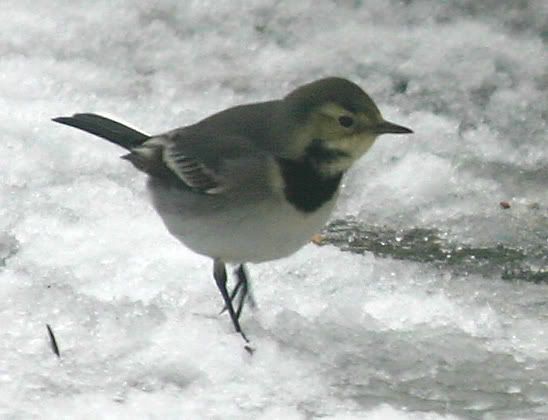
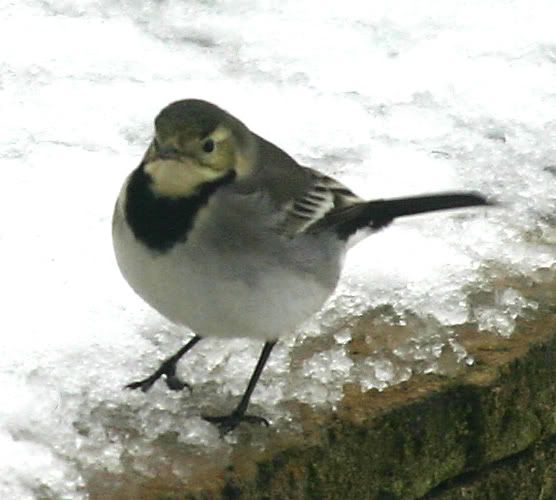
While it has been cold a solitary Wagtail has been feeding from the food we put on the ground - basic seed mix plus extra black sunflowers and bread crumbs - and seems to be taking either small seeds or crumbs, not the feed mentioned in any books for Wagtails. It doesn't seem to match any of the Wagtail pictures I can find on RSPB or BirdID or in my books. Not easy to photograph with telephoto through not the cleanest of windows. I assume from the bib it is a female / immature Pied Wagtail but the eye area doesn't seem quite right. Any ideas?

Image
Image
PLUMPUDDING
KG Regular
Posts: 3269
Joined: Mon Jan 07, 2008 10:14 pm
Location: Stocksbridge, S. Yorks
Been thanked: 1 time

Nice close-up photo. It looks like a juvenile white wagtail according to my book. "Birdwatcher's Pocket Guide to Britain and Europe" by Peter Hayman & Rob Hume. I'm not an expert though, so may be wrong.
Monika
KG Regular
Posts: 4546
Joined: Thu Jul 06, 2006 8:13 pm
Location: Yorkshire Dales

Geoff, I think it's a grey wagtail, probably one of last year's young. They breed near the beck here in the village and we regularly see them in winter. The slightly yellow tinge to the front would also suggest the grey, rather than pied wagtail.
User avatar
Johnboy
KG Regular
Posts: 5824
Joined: Tue Nov 22, 2005 1:15 pm
Location: NW Herefordshire

Hi Geoff,
I think that it is a case of paying your money and taking your chance with the identification of this bird. Certainly Wagtail, certainly a female but if you look at the black bib,which does not appear on a female Grey Wagtail, even during the juvenile and pre-adult stages.
I think that it is a female Pied Wagtail which is going through the final moult prior to adult plumage.
If you look in your second photo at the back, from the wing covets to the nape, it is grey which denotes female. The male goes through that stage but last autumn and we are seeing the adult spring feathers. His feathers are black at this stage of the proceedings.
I can see what Monika is getting at but the yellow never appears where this bird is showing slight yellowing in either male or female Grey Wagtails. Wagtails will pick a cowpat apart for grubs and emerging flies and what we are seeing is probably staining from that or some such sort of activity.
JB.
User avatar
Geoff
KG Regular
Posts: 5784
Joined: Thu Nov 24, 2005 5:33 pm
Location: Forest of Bowland
Been thanked: 319 times

Thanks for your help. I also sent it to a local expert and got this reply :

This is a first winter=second calender year Pied Wagtail with quite a bit of retained juvenile head plumage.

It is not a White Wagtail (which can look very similar in autumn but are all way south fo the British Isles at this time of year) because the bib is far too broad in the centre.

Grey Wagtail will be yellow underneath grading to buff/yellow on the throat/upper breast. Also a much slimmer bird with a longer tail.

Pied Wagtails are scarce in SD66 in winter [away from High Bentham sewage works], therefore this is a good atlas 'roving record'. Would you like to enter it yourself on the BTO Atlas site (and any other records you may have). Otherwise I can do it but need to know tetrad/grid ref.


So it seems I have a Pied and will have to see how the BTO website works!
User avatar
oldherbaceous
KG Regular
Posts: 14432
Joined: Tue Jan 24, 2006 1:52 pm
Location: Beautiful Bedfordshire
Has thanked: 711 times
Been thanked: 709 times

I think Johnboy deserves a pat on the back for his deduction.
Kind Regards, Old Herbaceous.

There's no fool like an old fool.
User avatar
Johnboy
KG Regular
Posts: 5824
Joined: Tue Nov 22, 2005 1:15 pm
Location: NW Herefordshire

Hi OH,
After 70 years as an avid birdwatcher it seems that I am actually begining to get something right!
JB.
Monika
KG Regular
Posts: 4546
Joined: Thu Jul 06, 2006 8:13 pm
Location: Yorkshire Dales

That was fascinating, I'll know next time - I hope.
User avatar
Geoff
KG Regular
Posts: 5784
Joined: Thu Nov 24, 2005 5:33 pm
Location: Forest of Bowland
Been thanked: 319 times

I only usually see them mature as I don't think they nest near us, they obviously go through quite a colour change. The immature colours are probably quite a good camouflage in grassland compared to the bold black and white of the mature birds. It is still here today even though the snow has gone.
The other strange (to us) behaviour we have had while it has been cold is Nuthatches feeding on the same seed and crumbs mixture on the floor. They are quite aggressive taking on the Blackbirds and Robins, mind you I think I would be a bit wary of that beak. I'll have to clean the windows and try for a photograph of one of them.
User avatar
Johnboy
KG Regular
Posts: 5824
Joined: Tue Nov 22, 2005 1:15 pm
Location: NW Herefordshire

Hi Geoff,
This time of year is very interesting in birdwatching circles. The last years adult birds, especially the tit family, have their breeding plumage but the last years youngsters may well have a combination and especially the young Blue Tits who may have a kind of powdery appearance.
I have two families of Nuthatch visiting the nuts and the males fight like mad and both females feed at the same time and take no notice of the fighting.. This also happens with the Black Backed Woodpeckers if they meet at the nuts both male and female fight and they generally then forget what they have come for and do not feed.
I have one Robin feeding from the nuts which is unusual. They do not have the right claw formation to cling on but this one seems to manage by flapping it's wings madly as it feeds.
Because I live very rurally and have no neighbours I do not have frosted glass in my bathroom and I sit on the loo with a lovely hot radiator close at hand birdwatching. Cheating I know but I am begining to feel the cold.
JB.
PLUMPUDDING
KG Regular
Posts: 3269
Joined: Mon Jan 07, 2008 10:14 pm
Location: Stocksbridge, S. Yorks
Been thanked: 1 time

The Wagtail info is really interesting. We don't get White wagtails here, just pied and grey, but I've never noticed the pied wagtails with yellow on them. Perhaps there have only been adults visiting here.

We're getting some lovely birds on the feeders and bird table with all this frost. This weeks specials are a pair of Brambling, five Bullfinch, heron, tree creeper and nuthatch and greater spotted woodpecker, and the usual large flocks of tits and finches. We had 20 species on Wednesday in less than an hour.

Glad I don't have to watch from the loo though - I sit on the bed.
Gerry
KG Regular
Posts: 428
Joined: Fri Mar 17, 2006 11:55 pm
Location: West Cork,

I can't think of anything nicer than a "Loo with a view" particularly when there is a lovely warm radiator near by.
Monika
KG Regular
Posts: 4546
Joined: Thu Jul 06, 2006 8:13 pm
Location: Yorkshire Dales

Johnboy, we get a robin regularly feeding on the nuts, just as you describe, and we often wonder whether it's really "worth it". They must use more energy than they actually obtain! Perhaps in time they will learn to cling on and their claws will adapt!

Until about 15 years ago, we never saw goldfinches clinging onto peanut/sunflower feeders which they now do with alacrity. At the time there was a lively correspondence debate in the "Country Life" magazine about these goldfinches and it appeared that the ability to cling on had gradually spread from southern UK northwards over the years. Goldfinches, of course, have always been feeding on seedheads like teasels and lavender, so the transfer to peanuts would not have been so drastic.

One species we have "lost" from the garden recently is the brambling. We used to get up to 40 feeding with chaffinches but have not seen one this year (a few last winter) but we have regained nuthatches which had not been for some time. Being only about half a mile from the open moor, we are also visited by reed buntings in winter, always nice to watch.
User avatar
Johnboy
KG Regular
Posts: 5824
Joined: Tue Nov 22, 2005 1:15 pm
Location: NW Herefordshire

Hi Monika,
I don't think it possible for a Robin to adapt because it is a ground feeding bird and it is the position of the Tarsus. With Goldfinches it is very different as they have only gone to feeders since the introduction of seeds feeders rather than nut feeders. They have an entirely different foot displacement to the Robin.
Wonderful view of two Kites this last morning and 4 Brambling last week but most excited as we have, all of a sudden, got an explosion od Waxwings. I counted 80 Saturday morning before they buggered off and I was no where near finishing my count. One Hawthorn hedge which 400 yards long and has been fetched up for laying next year was still full of berries for some unknown reason (The Redwing generally strip this hedge but didn't this year) But very sadly depleted by the evening.
I haven't seen a Reed Bunting but I generally do but probably more towards the spring.
JB.
AnneThomas
KG Regular
Posts: 97
Joined: Sat Oct 25, 2008 9:57 am
Location: Near Liskeard in Cornwall

As a relative newcomer (or should that be returner) I hope you don't mind me joining this discussion.

Plumpudding - Pied Wagtails don't have any yellow - unless as Johnboy suggests due to staining. Grey wagtails have more yellow as per the rspb link: http://www.rspb.org.uk/wildlife/birdgui ... /index.asp

The three usual wagtails we get in this country are pied, grey and yellow - the latter only as a summer visitor. I am not sure about white wagtails (Motacilla Alba) having not come across them before. If you put a search into the RSPB website for White Wagtail, they show Pied Wagtail as Motacilla Alba, whereas Wikipedia suggest that Pied is a sub-species of White and show the latin name of pied as M a yarrellii. Birdguides suggest two races of this species (M alba):

"There are two races of this species in Europe, since the wagtails in Britain and Ireland have darker backs and are known as Pied Wagtails. In the White Wagtails of mainland Europe, the back is storm-cloud grey and the black nape and black bib which border the white face don't meet at the side of the neck."

I certainly don't have Johnboy's experience so I hope I have got this right.

Off-subject a bit, I have just seen (about 2pm) about 4 long-tailed tits on my feeders getting very blown about by the Cornish winds this afternoon.

Anne
Post Reply Previous topicNext topic