Potato Planting Yesterday in Jersey (mk2)
Posted: Mon Jan 28, 2008 9:24 pm
At last thanks to my friend in Jersey I've managed to load the pictures of Potato Planting yesterday in Jersey together with his description.
Preparing a côtil (steeply sloping field) this morning for planting Jersey Royal potatoes.
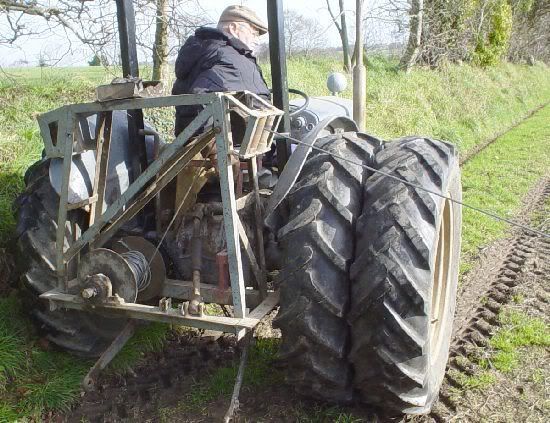
And here's the winch, made in Jersey by L.C.Pallot & Sons, the agricultural engineers who created our steam & agricultural museum. Two arms fit beneath the tractor's axle and the winch is secured by the top link. It is chain driven from a sprocket on the PTO shaft, with a dog clutch between the driven sprocket and the winch drum. The right hand is on the clutch lever, the horizontal handle of which is just visible.
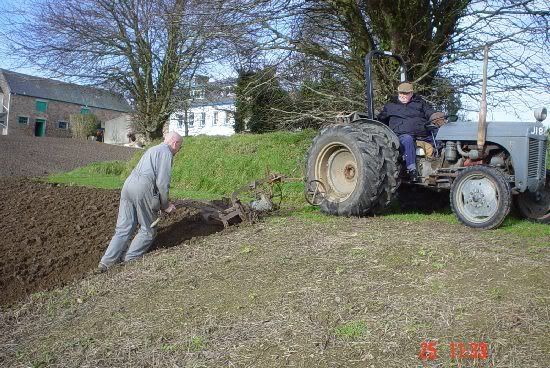
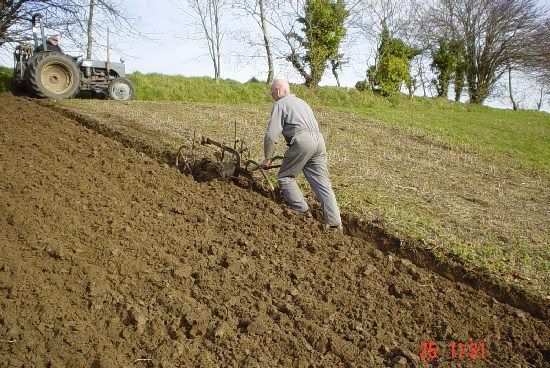
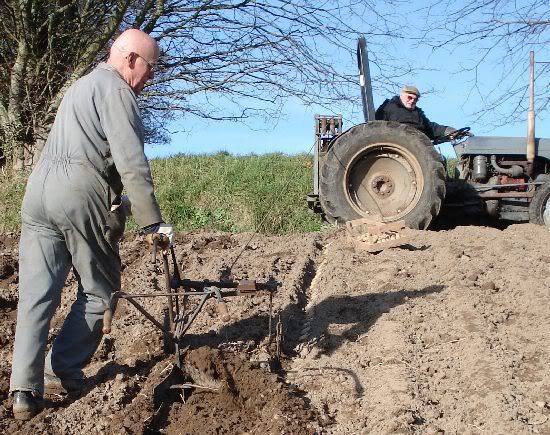
We lift the plough by its handles and stagger down the hill with it as the cable pays itself out. Note the double handles on the plough to facilitate this. On really steep fields I've seen people running down with the lighter, potato planting ploughs, one of which I hope to picture our aliens using soon. ...
I'm told that the winch's dog clutch was a welcome improvement: previous winches relied on the tractor's clutch and PTO engagment, thus with old grey fergies the man pulling the plough down the field was also having to overcome the resistance of the not-so-freewheeling hydraulic pump.
Hard work, but a vast improvement on having to dig by hand, as horses take exception if you try to connect a PTO shaft.
The reward is earlier potatoes, therefore a higher price because the early côtils face south into the sun, warming the soil. In recent years, fields of potatoes have been covered in polythene and sometimes fleece to achieve an even earlier crop. From the air the island appears to be covered in lakes, confusing visitors flying in &, occasionally, uneducated birds.
Every tiny côtil is used (perhaps less so now than in the old days) and tonight's local newspaper has a photo of men planting potatoes in a commercial field of only ten square yards (not ten yards square, ten square yards) with the caption "is this the smallest field in Jersey?"
As promised, pictures of the planting plough in action this afternoon. In October, staff were employed in "standing" the seed potatoes i.e. placing them on end, the right way up, in a single layer in the potato boxes seen here so that their shoots develop in the same direction. The boxes are stacked in a loft in single rows to allow light to reach the potatoes. I've just realised that this is what is called "chitting" in the UK; I was thinking that the method was unique to Jersey until it occurred to me that we do refer to "chitting lights" (fluorescent tubes used on end to provide light between the rows) prompting me to look up "chitting". My apologies. Other than in "chitting lights" I've never heard the word used in Jersey; we always say "standing".
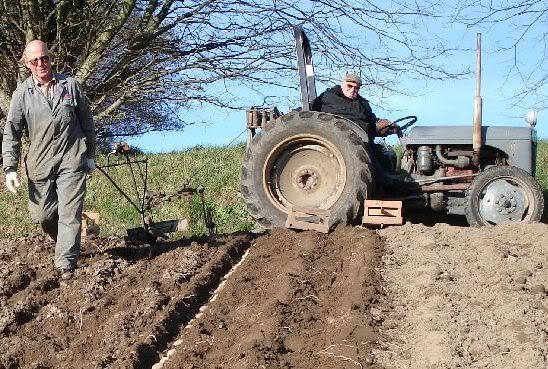
Once the shoots have developed the potatoes are planted, as seen here, individually by hand with their shoots pointing upwards, as I now realise that you already know!
The furrow is only three to four inches deep; the furrow wheel is very thin, about 3mm, to clear the potatoes. The mouldboard is about 20 inches (500mm) long, and is adjustable by means of a hook (visible in the top photo) engaging one of a number of holes behind it to select the distance between rows. The soil is not turned over as with a normal plough, it just slides across to the previous furrow to cover the potatoes.
This field is now covered with fleece in anticipation of tonight's frost.
What goes up:
...must come down:
Oh yes; the tractor: TEF 511292, delivered by the local Ferguson agent on October 11th 1956 to another local garage, probably for one of the second garage's customers.
Regards
Ian
My thanks to fellow Ferguson fan and potato buff Ian.
Best wishes
Barney
Preparing a côtil (steeply sloping field) this morning for planting Jersey Royal potatoes.
And here's the winch, made in Jersey by L.C.Pallot & Sons, the agricultural engineers who created our steam & agricultural museum. Two arms fit beneath the tractor's axle and the winch is secured by the top link. It is chain driven from a sprocket on the PTO shaft, with a dog clutch between the driven sprocket and the winch drum. The right hand is on the clutch lever, the horizontal handle of which is just visible.
We lift the plough by its handles and stagger down the hill with it as the cable pays itself out. Note the double handles on the plough to facilitate this. On really steep fields I've seen people running down with the lighter, potato planting ploughs, one of which I hope to picture our aliens using soon. ...
I'm told that the winch's dog clutch was a welcome improvement: previous winches relied on the tractor's clutch and PTO engagment, thus with old grey fergies the man pulling the plough down the field was also having to overcome the resistance of the not-so-freewheeling hydraulic pump.
Hard work, but a vast improvement on having to dig by hand, as horses take exception if you try to connect a PTO shaft.
The reward is earlier potatoes, therefore a higher price because the early côtils face south into the sun, warming the soil. In recent years, fields of potatoes have been covered in polythene and sometimes fleece to achieve an even earlier crop. From the air the island appears to be covered in lakes, confusing visitors flying in &, occasionally, uneducated birds.
Every tiny côtil is used (perhaps less so now than in the old days) and tonight's local newspaper has a photo of men planting potatoes in a commercial field of only ten square yards (not ten yards square, ten square yards) with the caption "is this the smallest field in Jersey?"
As promised, pictures of the planting plough in action this afternoon. In October, staff were employed in "standing" the seed potatoes i.e. placing them on end, the right way up, in a single layer in the potato boxes seen here so that their shoots develop in the same direction. The boxes are stacked in a loft in single rows to allow light to reach the potatoes. I've just realised that this is what is called "chitting" in the UK; I was thinking that the method was unique to Jersey until it occurred to me that we do refer to "chitting lights" (fluorescent tubes used on end to provide light between the rows) prompting me to look up "chitting". My apologies. Other than in "chitting lights" I've never heard the word used in Jersey; we always say "standing".
Once the shoots have developed the potatoes are planted, as seen here, individually by hand with their shoots pointing upwards, as I now realise that you already know!
The furrow is only three to four inches deep; the furrow wheel is very thin, about 3mm, to clear the potatoes. The mouldboard is about 20 inches (500mm) long, and is adjustable by means of a hook (visible in the top photo) engaging one of a number of holes behind it to select the distance between rows. The soil is not turned over as with a normal plough, it just slides across to the previous furrow to cover the potatoes.
This field is now covered with fleece in anticipation of tonight's frost.
What goes up:
...must come down:
Oh yes; the tractor: TEF 511292, delivered by the local Ferguson agent on October 11th 1956 to another local garage, probably for one of the second garage's customers.
Regards
Ian
My thanks to fellow Ferguson fan and potato buff Ian.
Best wishes
Barney
