
I am thinking of scarifing my lawn never done it before are there any points i should look out for
I am worried in case i mess it up
many thanks
Anthony
scarify
Moderators: KG Steve, Chantal, Tigger, peter, Chief Spud
-
Chantal

- KG Regular
- Posts: 5665
- Joined: Thu Nov 24, 2005 9:53 am
- Location: Rugby, Warwickshire
- Been thanked: 1 time
Hi Anthony
I can't comment much on the tips as I've only ever gone over mine with a rake. However, my vast experience of lawns (:lol: ) has taught me that no matter what you do to them, short of digging them up and composting them, they always grow back.
I had a great chicken escape and 12 of my girls trashed my lawn in 30 minutes. It took a month or two, but it came back as good as new, and I didn't do anything except watch it.
I can't comment much on the tips as I've only ever gone over mine with a rake. However, my vast experience of lawns (:lol: ) has taught me that no matter what you do to them, short of digging them up and composting them, they always grow back.
I had a great chicken escape and 12 of my girls trashed my lawn in 30 minutes. It took a month or two, but it came back as good as new, and I didn't do anything except watch it.
Chantal
I know this corner of the earth, it smiles for me...
I know this corner of the earth, it smiles for me...

-
Geoff

- KG Regular
- Posts: 5806
- Joined: Thu Nov 24, 2005 5:33 pm
- Location: Forest of Bowland
- Been thanked: 347 times
I'm not posh enough for a lawn I only have grass. I think scarifying with a spring rake is one of the most knackering jobs there is so good luck - the only thing you can damage is yourself.
-
Clive.

- KG Regular
- Posts: 2300
- Joined: Thu Nov 24, 2005 5:01 pm
- Location: East Lincolnshire.
- Has thanked: 80 times
- Been thanked: 470 times
At home here I tend to scarify the front lawn in the Spring...for this I use an electric Atco Lawnraker..that dates from the 1980s This light duty domestic machine has rows of spring tines on a revolving shaft..it was actually developed by Qualcast/Atco using the chassis of the old Qualcast RE35DL electric cylinder mower.
It has a box to collect the rakings but the collection system is not 100% so after having used the raker in possibly 3 or 4 different directions across the lawn I follow up with a rotary mower with grassbox..efectively using this to vacuum up any thatch left by the raker. This is followed by a cut with the Atco cylinder mower. I then give the lawn a gentle feed with granular growmore fertiliser applied by hand.
This operation in Spring sets the lawn up for the season ahead removing any straggling flat growths of grass and gives a lovely upright regrowth..and really cheers the job up after a long Winter.
...At work we scarify mainly the more formal lawn areas...sometimes a light scarify in the Spring but more often we give a heavy treatment about now...not every year but as required. This goes best if the soil is damp..but not if too wet..or too dry. At the moment our lawns are starting to show some slight stress at the edges near gravel path sides and under trees so it is perhaps getting a bit drier than good for us to scarify as the recovery would be slower. There are however some good dews so it may be ok.
We use a scarifying bar that fits in place of the blade of a petrol rotary mower. It is a similar flat bar to the blade but has attached near the ends two replaceable metal tines. I should add that in my previous employment in the mower world the manufacturers that we were service agents for frowned on these scarifier bars and they would invalidate machine warranties. We use the bar on a 1995 Hayterette 5hp mower, rather than our best new mower, and it makes it grunt...so anything less hp may not be good.
The scarifying bar gives gives a much harder scarify than the machine I use at home. We often go over the lawn 3 or 4 directions as required raking up the removed thatch between passes...and like at home a final vacuum up with a rotary mower with grassbag.
The effect is quite dramatic..especially if you forget to lift the tines clear of the lawn and add a few circular "roundels" to the lawn....but after a few weeks a green lawn will return. We sometimes spread a very thin layer of riddled soil over the area and rake in...and with some late scarifying we have even spread some very well rotted cow manure and left this to weather in over the Winter giving it a several rakings with a plastic lawn rake until it eventually works in...not quite "by the book" but it works for us.
I used to work for a company that hired out a commercial scarifier that used thin metal tines on a shaft as the scarfying action...this worked ok but as soon as the point of the tines got worn the result was poorer...most users hiring a machine would really give it some work...wereas if the same machine was owned by a bowls club for instance it would only be used on one or two greens and stay in good health for longer.
So if hiring a machine do check well that the tines a re in very good order.
On a much lesser scale there were sold a few years ago a hand rake I think called a Scrake?? that had a curved back to the tines and so the rake could be pushed back on the lawn surface and then pulled forward to rake without the need to lift the rake back as would be the action with a spring rake.
I may post up some photos later...if I can find some of the above operations.
All the best,
Clive.
It has a box to collect the rakings but the collection system is not 100% so after having used the raker in possibly 3 or 4 different directions across the lawn I follow up with a rotary mower with grassbox..efectively using this to vacuum up any thatch left by the raker. This is followed by a cut with the Atco cylinder mower. I then give the lawn a gentle feed with granular growmore fertiliser applied by hand.
This operation in Spring sets the lawn up for the season ahead removing any straggling flat growths of grass and gives a lovely upright regrowth..and really cheers the job up after a long Winter.
...At work we scarify mainly the more formal lawn areas...sometimes a light scarify in the Spring but more often we give a heavy treatment about now...not every year but as required. This goes best if the soil is damp..but not if too wet..or too dry. At the moment our lawns are starting to show some slight stress at the edges near gravel path sides and under trees so it is perhaps getting a bit drier than good for us to scarify as the recovery would be slower. There are however some good dews so it may be ok.
We use a scarifying bar that fits in place of the blade of a petrol rotary mower. It is a similar flat bar to the blade but has attached near the ends two replaceable metal tines. I should add that in my previous employment in the mower world the manufacturers that we were service agents for frowned on these scarifier bars and they would invalidate machine warranties. We use the bar on a 1995 Hayterette 5hp mower, rather than our best new mower, and it makes it grunt...so anything less hp may not be good.
The scarifying bar gives gives a much harder scarify than the machine I use at home. We often go over the lawn 3 or 4 directions as required raking up the removed thatch between passes...and like at home a final vacuum up with a rotary mower with grassbag.
The effect is quite dramatic..especially if you forget to lift the tines clear of the lawn and add a few circular "roundels" to the lawn....but after a few weeks a green lawn will return. We sometimes spread a very thin layer of riddled soil over the area and rake in...and with some late scarifying we have even spread some very well rotted cow manure and left this to weather in over the Winter giving it a several rakings with a plastic lawn rake until it eventually works in...not quite "by the book" but it works for us.
I used to work for a company that hired out a commercial scarifier that used thin metal tines on a shaft as the scarfying action...this worked ok but as soon as the point of the tines got worn the result was poorer...most users hiring a machine would really give it some work...wereas if the same machine was owned by a bowls club for instance it would only be used on one or two greens and stay in good health for longer.
So if hiring a machine do check well that the tines a re in very good order.
On a much lesser scale there were sold a few years ago a hand rake I think called a Scrake?? that had a curved back to the tines and so the rake could be pushed back on the lawn surface and then pulled forward to rake without the need to lift the rake back as would be the action with a spring rake.
I may post up some photos later...if I can find some of the above operations.
All the best,
Clive.
Last edited by Clive. on Sat Sep 15, 2007 4:01 pm, edited 4 times in total.
-
Clive.
- KG Regular
- Posts: 2300
- Joined: Thu Nov 24, 2005 5:01 pm
- Location: East Lincolnshire.
- Has thanked: 80 times
- Been thanked: 470 times
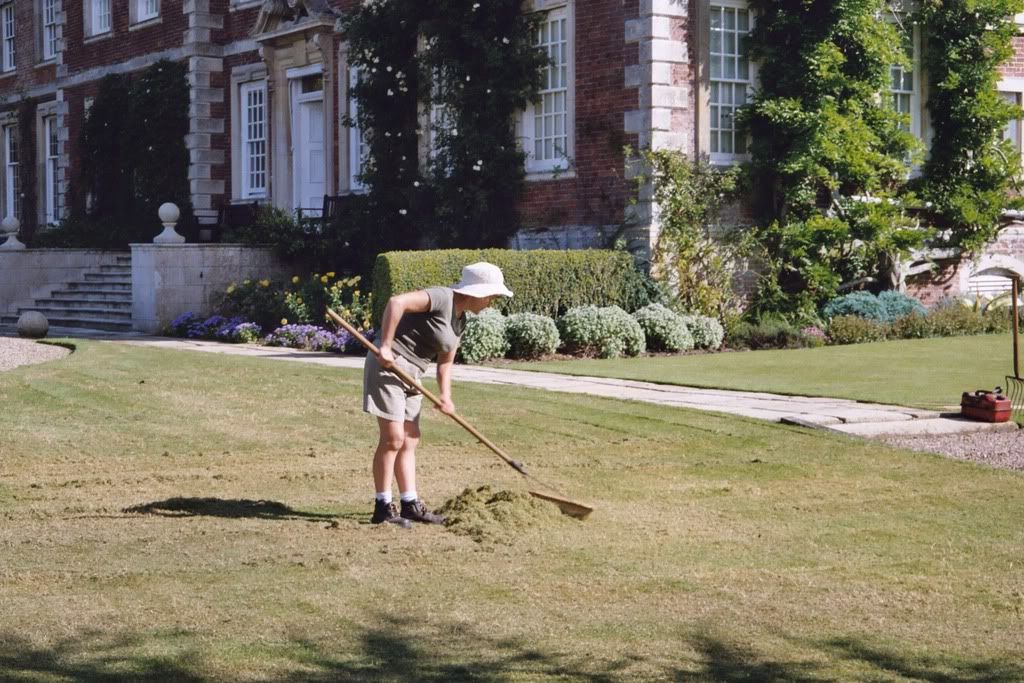
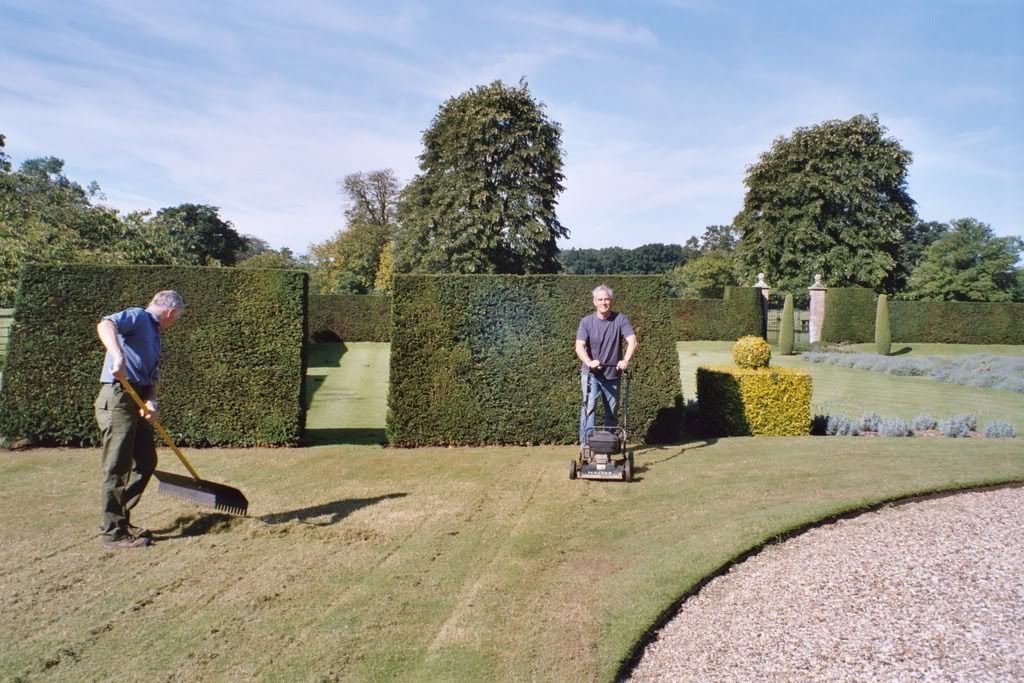
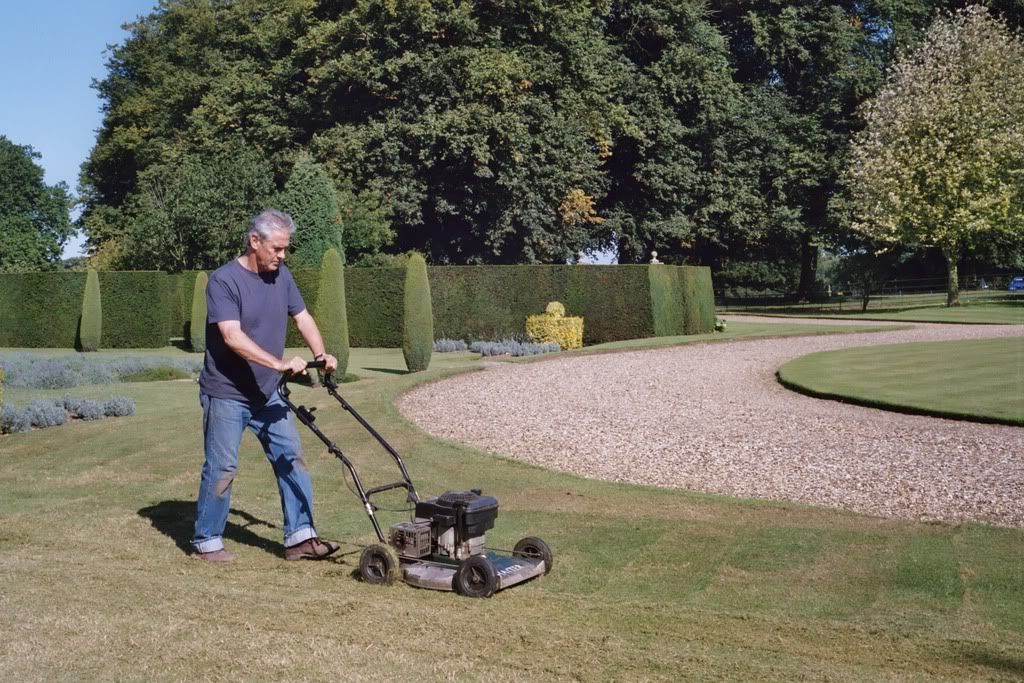
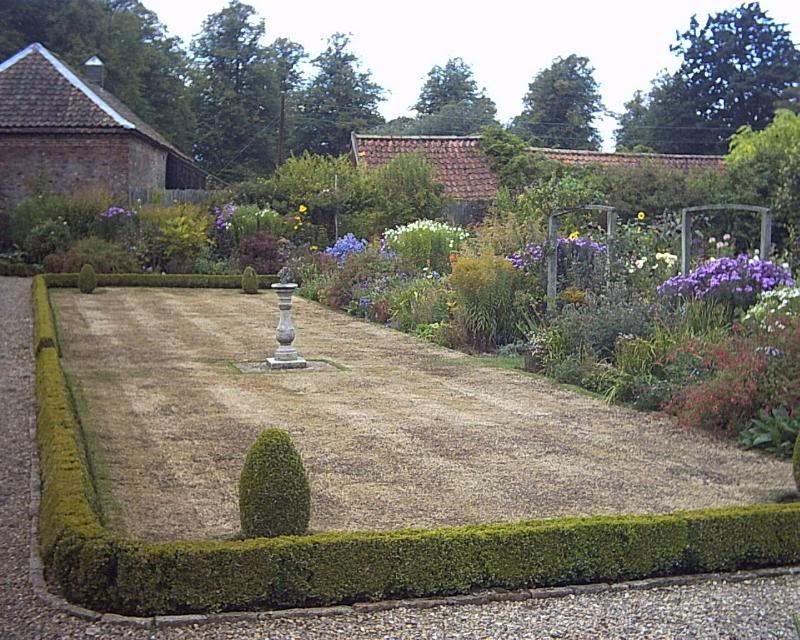
The first 3 photos should really be in reverse order.

Top photo..raking up the removed thatch into heaps with Chellwood rake.
2nd photo..Hayterette with scarifier bar..and also raking up thatch with Nottingham rake.
3rd photo...the Hayterette with scarifier bar...and keen Volunteer driver.
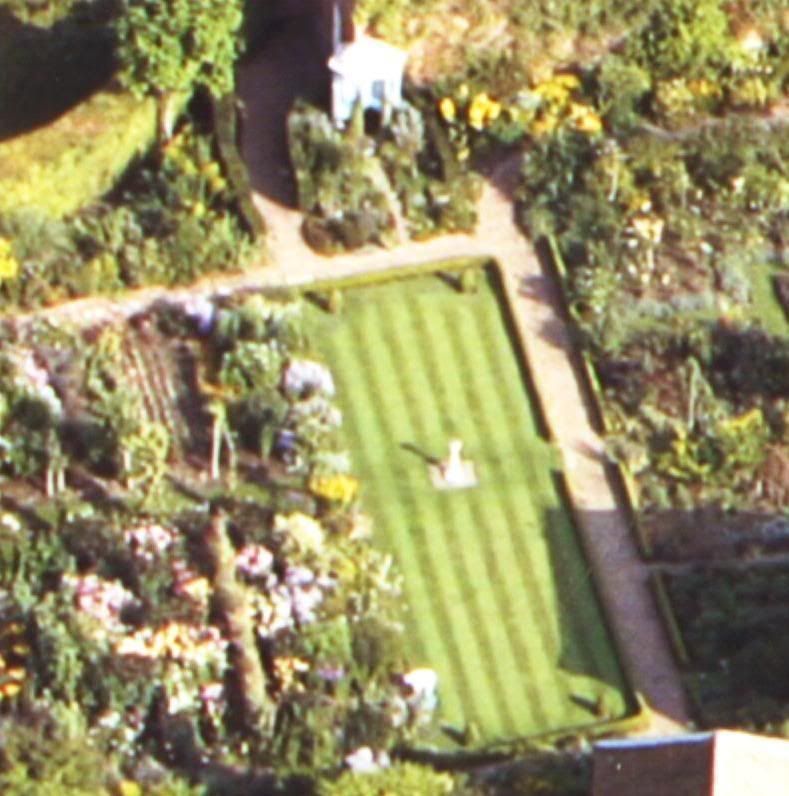
The 4th photo is of the sundial lawn immediately after having been scarified and then lightly top dressed with riddled top soil...I am strugling at present to find a photo of it recovering.
but I assure you it did.!!
Last edited by Clive. on Sat Sep 15, 2007 3:38 pm, edited 3 times in total.
-
anthony
Chantel- geoff-clive- richard p.
Thank you all for your input
Clive your photo N03 is that how a lawn looks after scarifying
Anthony
Thank you all for your input
Clive your photo N03 is that how a lawn looks after scarifying
Anthony
-
Clive.
- KG Regular
- Posts: 2300
- Joined: Thu Nov 24, 2005 5:01 pm
- Location: East Lincolnshire.
- Has thanked: 80 times
- Been thanked: 470 times
Hello Anthony,
I posted the photos in a mad tearing rush and they came up in reverse order.
I have gone back and ammended the words...I haven't posted much lately and made up for it with one massive post within which I tied myself in knots.
The ones showing raking by hand..is purely the raking up of the thatch removed from the lawn by the Hayerette mower fitted with the scarifier bar.
Clive.
I posted the photos in a mad tearing rush and they came up in reverse order.
I have gone back and ammended the words...I haven't posted much lately and made up for it with one massive post within which I tied myself in knots.
The ones showing raking by hand..is purely the raking up of the thatch removed from the lawn by the Hayerette mower fitted with the scarifier bar.
Clive.

Hello Anthony
Scarifying is well worth doing if you have the time and energy. I have a scarifying attachment that fits my Honda mini-tiller and this does a very good job. Its doesn't pick up though so there's raking to be done afterwards then a mow with a rotary + box. You must do it during a spell of damp weather then the grass which will look a bit shell-shocked at first will soon recover. Also do it in the Spring or Autumn as the grass is growing strongly at this time.
You will finish up with a lot of stuff that is mainly moss, weed bits and grass trimmings. This is not the same as grass mowings -it will regenerate quickly if simply used as a mulch or dug into the soil. You'll have to compost it properly and it will eventually make superb compost. One year I tried storing it in black poly bags and that worked well as it eventually killed everything and produced a light mossy-like material that could go straight onto the veg. patch.
John
Scarifying is well worth doing if you have the time and energy. I have a scarifying attachment that fits my Honda mini-tiller and this does a very good job. Its doesn't pick up though so there's raking to be done afterwards then a mow with a rotary + box. You must do it during a spell of damp weather then the grass which will look a bit shell-shocked at first will soon recover. Also do it in the Spring or Autumn as the grass is growing strongly at this time.
You will finish up with a lot of stuff that is mainly moss, weed bits and grass trimmings. This is not the same as grass mowings -it will regenerate quickly if simply used as a mulch or dug into the soil. You'll have to compost it properly and it will eventually make superb compost. One year I tried storing it in black poly bags and that worked well as it eventually killed everything and produced a light mossy-like material that could go straight onto the veg. patch.
John
The Gods do not subtract from the allotted span of men’s lives, the hours spent fishing Assyrian tablet
What we observe is not nature itself, but nature exposed to our method of questioning Werner Heisenberg
I am a man and the world is my urinal
What we observe is not nature itself, but nature exposed to our method of questioning Werner Heisenberg
I am a man and the world is my urinal
-
oldherbaceous

- KG Regular
- Posts: 14474
- Joined: Tue Jan 24, 2006 1:52 pm
- Location: Beautiful Bedfordshire
- Has thanked: 743 times
- Been thanked: 738 times
Dear Clive, i was just taking a look at the photo of the recovered lawn, and i didn't realize you were that tall. 
Kind Regards, Old Herbaceous.
There's no fool like an old fool.
There's no fool like an old fool.
-
peter

- KG Regular
- Posts: 5879
- Joined: Fri Nov 25, 2005 1:54 pm
- Location: Near Stansted airport
- Has thanked: 23 times
- Been thanked: 81 times
- Contact:
I hired a scarifying machine form a tool shop about twenty years ago and did my mother large lawn with it.
It had a collection of double jointed knives on a two bar cylinder mower style bar under a very deep rotary mower type deck.
It made the freshly mowed lawn look like a hay meadow freshly tedded.
It had a collection of double jointed knives on a two bar cylinder mower style bar under a very deep rotary mower type deck.
It made the freshly mowed lawn look like a hay meadow freshly tedded.
Do not put off thanking people when they have helped you, as they may not be there to thank later.
I support http://www.hearingdogs.org.uk/
I support http://www.hearingdogs.org.uk/