Page 1 of 2
Mice
Posted: Thu Feb 09, 2006 12:48 pm
by Myra.Westwood@Talk21.com
I was having fun sowing pea seeds into drain pipes and leaving in the greenhouse. Peas are now scattered or eaten. Tried putting net round pipe but they have still got to the peas. I will have to start again - any ideas to make greenhouse mouse proof.
Posted: Thu Feb 09, 2006 1:07 pm
by richard p
the simple answere is its impossibe, either shut the cat in there every night, which will probably do more damage, or use mousetraps, ive got a selection of the sprung wooden ones on the bench with the seed trays. or u could try the river cottage approach and ask them to leave quietly, i cant remember did it work for hugh? or was it just good telly

Posted: Thu Feb 09, 2006 1:09 pm
by Chez
Hello Myra
I notice you are using your email address as your user name. If you want to avoid unwelcome email attention, I would change this promptly to something that doesn't identify your email address so publicly. Just a thought.
Re the mouse problem, how frustrating. We have had this problem outside (overcome by using wire mesh), but not in the greenhouse. Short of blocking up the the access points or putting wire mesh around internal perimeter of the greenhouse, I would lay traps.
see micky mouse
Posted: Thu Feb 09, 2006 2:26 pm
by paul.r.
been having similar probs and posted earlier below.Its got to be the barrier method i reckon although a man who lives near me and is a national Sweetpea champion and grows hundreds swears by traps, but either way its an on going battle this time of year. I use small size netting stretched over onto nails but its a pain and has to be high enough so that the sweet peas dont grow through it. the prob regarding my onion seedlings and the fruit tree bark where i work, for which i posted earlier was new to me but apparently they'll try most things if there hungry enough. rgds Paul.
Posted: Thu Feb 09, 2006 2:36 pm
by pigletwillie
My greenhouse is situated next to my workshop, along one wall of which is our log store. Mice obviously live in it as do overwintering amphibians and the mice get into the greenhouse via "the great escape" style tunnels.
The only time they caused a problem wast last spring where a pair of them ate off the tops of my 2 week old sweetcorn seedlings and snaffled the seed. Some 60 plants went down before I unfortunatly decided to trap them. As the sweetcorn was so tasty they ignored a bit of mars bar on the first night but a bit of peanut butter lured them in on the second. Now when I sow tasty items like sweetcorn, peas etc, out come the traps.
Posted: Thu Feb 09, 2006 5:44 pm
by Geoff
But you don't always catch what you expect - something was eating our melons but I'm sure it wasn't this!
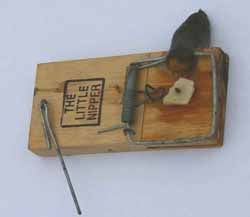
Does it tell us about the size of our slugs or the sensitivity of our trap?
Posted: Thu Feb 09, 2006 5:56 pm
by paul. r
at the garden centre where i work another hot spot for the varmits is the bird food etc. obviously tempting them away from the feast to the trap can be difficult but sun flower hearts on those little plastic traps works every time. regds paul.
Posted: Thu Feb 09, 2006 9:32 pm
by LakeView
I recognise the variety of slug. We have lots of those in our garden, too! (Plus long leopard slugs that take a strong will to dispose of... if you know what I mean).
As for mice, I was digging my raised bed after it was laid dormant for a while and out hopped three mice! Don't know if they were blind!

mice and peas
Posted: Thu Feb 09, 2006 9:38 pm
by Beryl
Just an idea this is how I grow mine - sow them in 3" pots (5 to a pot) and cover with the cheap plastic propagator lids till they have germinated and growing well.
An old chap on our lottie would soak his peas first in liquid paraffin before planting. I am not recommending it tho'. not having trird it myself.
Beryl.
Posted: Thu Feb 09, 2006 10:14 pm
by Geoff G
Soaking peas in parafin has worked for me for a number of years now all they need is a quick dunk
Posted: Thu Feb 09, 2006 10:44 pm
by jane E
An old chap on our allotment suggested paraffin when I was a novice allotmenteer. No 'suggested' is not the word. He commanded us to use it, in the same way that all his advice was given.I've never had trouble with peas and mice since. I have a jamjar handy with a little in the bottom. I tip them in and then out and sow them. You always get a few drops on the soil and that warns them off. 'These peas are paraffin soaked' - no need of a notice!You would need traps for nibbling plants though.Could you empty them? I don't think I could, Being a bit squeamish.
Posted: Fri Feb 10, 2006 4:27 pm
by Beccy
Mice can get through a hole the size of the end of a pencil, they dislocate their jaws to do so. They can also 'chimney', like a climber, up cracks. It is virtually impossible to mouse or rat proof buildings of any sort. You can deter them to an extent with the sonic machines. Your best bet is to poison them putting the poison in pet-proof bait boxes.
And believe me, on most things I am fluffy and friendly, but I buy my flour by the 32kg sack and I will not risk having to chuck the lot because of rodent contamination.
Oh just to really wind you up Lakeview, Leopard slugs are a protected species! I have them too, and a friend who is the local Council's ecologist. Does that stop me killing them? What do you think

Two things, no four things
Posted: Fri Feb 10, 2006 9:01 pm
by fen not fen
1. Leopard slugs - wow didn't know they were protected, but I wouldn't kill them anyway as they only seem to eat decomposing stuff - I've only ever found them in the compost
2. mice & peas, a well known Afro Carribean dish, oops no that's rice & peas. Anyway, I'm going to try pre-sprouting the peas & beans before sowing them (I'm registered organic and would be amazed if soaking in paraffin is allowed). We've had terrible problems with rats & mice this winter.
3. I went off the snap traps after catching a Thrush in one (in a tunnel under a cover as well)
4. how do i save the slug picture as a screen saver?
Leopard slugs...
Posted: Fri Feb 10, 2006 11:25 pm
by LakeView
Methinks windup:
I found two references online. Several pages into a Google search...
From
www.buglife.org.uk
The Leopard slug Limax maximus is featured in programme 1 of Life in the Undergrowth. It is found in the UK and with its pinkish grey body and black spots it is one of our most attractive slugs. This is a fairly big slug for this country, they can grow up to 16cm long, and they can live for seven years or more. Leopard slugs are widespread and common throughout most of Britain and Ireland and can often be found in woodland and gardens.
but
Geomalacus maculosus (Allman, 1846): This slug is one of the most beautiful on Earth. The body is black covered in beautiful white spots and has black antennae. Feeds on plants and lichen. This slug can roll itself into a ball! In Killarney national park, Ireland, this species is protected. It is included on the Euopean Union habitats and species directive (EUHSD) this directive strives to conserve vunerable species. Also in Brittany, north-west Spain and Portugal.
and thanks...
L. maximus is not native to North America, but yet another of the throngs of organisms "brought over by European settlers." Whew. One envisions armadas of arks making their way across the Atlantic in colonial times.
http://nuthatch.typepad.com/ba/2005/05/
but you had me going for a little while.
Posted: Sat Feb 11, 2006 2:58 am
by Beccy
Maybe they are locally rare and that was what ecologist friend meant? Dunno, but we didn't have them in Wolverhampton or Oxford when I lived there.