
I haven't seen much about raised deep beds on the forum, no dig and all that. It seems a good idea on the face of it but how does it work out in practice when you are planting tomato plants, sprouts, squashes which are widely spaced. It seems to me that in the first place at least when you create the bed you would need at least 4 inches depth of
organic material, all very nice if you can get it and a lot of hard work carting it in but if you have to buy it in you would need a lot of material and at about £2 a sack which is the cheapest I see that's a lot of money. If you are starting out you won't have your own composted material for at least a year and in my experience there never is enough to go round. My method for these individual plantings is to dig a hole several inches deep and put about a quarter of a 15 litre bucketful in per plant and mix well with the soil then plant in that. If the plants are at 1 metre spacing you wouldn't ever have enough material to cover the whole area with compost.
I can see the sense for area cropping such as salad crops where there isn't all this space between plants. In the polytunnels I had to use 4 sacks per bay of approx 4 sq.metres to make a real difference, that was 64 sacks, costing over £100.
I remember seeing a programe which was an interview with a SA boss, he reckoned to be self-sufficient for compost for his vegetable but they only represented a fraction of his total acreage so I think he must have been taking material off the whole acreage to feed the vegetables. Bringing in compost is robbing the place that produces it and this means in many instances that chemical fertilisers would have to be used to create that FYM or horse muck.
Opinions and facts please.
Allan
Practicality of deep beds
Moderators: KG Steve, Chantal, Tigger, peter
I made some beds late last year and luckily for me a local stables gives manure away free!! they even bag it up for you. The beds were made with some floorboards from my relatives house that was being refurbished.
I put 6" of manure in the bottom and covered with soil from around the plot. It was then covered with a weed suppressing membrane which let air and water through but not light.
They have been very successful as I am not walking on the soil it is not getting compacted (very clay around here). I am thinking of building some more to sow carrots in next year and possibly Strawberries. Its also very satisfying for a 'Frank Spencer' like myself to see something I have built being used !!
I put 6" of manure in the bottom and covered with soil from around the plot. It was then covered with a weed suppressing membrane which let air and water through but not light.
They have been very successful as I am not walking on the soil it is not getting compacted (very clay around here). I am thinking of building some more to sow carrots in next year and possibly Strawberries. Its also very satisfying for a 'Frank Spencer' like myself to see something I have built being used !!

Hi Allan, I don't dig, and have settled on a bed system with 38 beds approx. 1.1m wide and 4m long on my two allotments. Eight of these are perennial veg/fruit. Paths are 60-80cm between beds, and 1m the length of the plot.
To start with, potatoes, leeks and squash were planted, 2 sacks of spent hops and a barrowful of horse manure (both supplied f.o.c. to our allotments) were laid as mulch on each bed, and the whole thing covered in permeable plastic film.
Harvesting incorporated the mulch into the soil, and I have used more mulch and compost since. I have never 'dug' the soil except to harvest. I use a bulb planter or dibber for transplanting. The beds raise themselves above the paths 'by default', and have no edges. Up to this year I have hoed the weeds off the paths, and this year am covering them with newspaper and straw. I still use a LOT of mulch.
For me, the advantage of undug beds is:
a) manageable chunks of work (good for Morale )
)
b) plenty of room to move around and enjoy the plot
c) flexible - one or several crops per bed, lots of opportunities for catch cropping e.g. lettuce
d) intensive planting means minimal weeding
e) holds the moisture - the difference between dug and undug soil on my plot is spectacular
f) standard modular size makes using cloches and mesh easy
g) veg I enjoy eating seem to enjoy growing in them!
We produce more than enough compost from the plot and kitchen to lay on the beds now, supplemented by chicken manure pellets, green manures, comfrey and BF&B. I can recommend this approach for anyone who prefers not to dig!
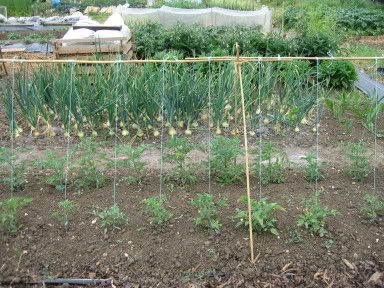

I think there are a variety of reasons why people would choose a bed system - these are mine!
To start with, potatoes, leeks and squash were planted, 2 sacks of spent hops and a barrowful of horse manure (both supplied f.o.c. to our allotments) were laid as mulch on each bed, and the whole thing covered in permeable plastic film.
Harvesting incorporated the mulch into the soil, and I have used more mulch and compost since. I have never 'dug' the soil except to harvest. I use a bulb planter or dibber for transplanting. The beds raise themselves above the paths 'by default', and have no edges. Up to this year I have hoed the weeds off the paths, and this year am covering them with newspaper and straw. I still use a LOT of mulch.
For me, the advantage of undug beds is:
a) manageable chunks of work (good for Morale
)
b) plenty of room to move around and enjoy the plot
c) flexible - one or several crops per bed, lots of opportunities for catch cropping e.g. lettuce
d) intensive planting means minimal weeding
e) holds the moisture - the difference between dug and undug soil on my plot is spectacular
f) standard modular size makes using cloches and mesh easy
g) veg I enjoy eating seem to enjoy growing in them!
We produce more than enough compost from the plot and kitchen to lay on the beds now, supplemented by chicken manure pellets, green manures, comfrey and BF&B. I can recommend this approach for anyone who prefers not to dig!
I think there are a variety of reasons why people would choose a bed system - these are mine!
I think both of you have missed the point.I am not disputing the principle of the deep bed, in fact I go that way when I can, but anything will grow well given a diet of what amounts to horticultural caviare.
However when I am planting, for instance, 45 squashes across 100 ft of clay-like soil it doesn't make sense on economics or effort to convert the whole strip to deep bed when most of it would be covered by sprawling plant or pathway to access the crop. I say horses for courses. In the world of commercialism if you don't get back more than it costs you then you go out of business.
I go so far with you as to not digging in a meagre organic resource a full spit deep, I mostly stir such things in only a few inches if at all. In the course of time some of that material will work its way deeper down.
Neither of you specify what type of soil you are starting with, I spent 40 years on riverbed sandy soil and am now on a soil that, untreated, switches from liquid mud in winter to a rocklike hardness from May onwards, neither is conducive to the best in plants. The minimum treatment to make any real difference is at least 40 litres of organic material per square metre, but only on the intensive area.
Allan
However when I am planting, for instance, 45 squashes across 100 ft of clay-like soil it doesn't make sense on economics or effort to convert the whole strip to deep bed when most of it would be covered by sprawling plant or pathway to access the crop. I say horses for courses. In the world of commercialism if you don't get back more than it costs you then you go out of business.
I go so far with you as to not digging in a meagre organic resource a full spit deep, I mostly stir such things in only a few inches if at all. In the course of time some of that material will work its way deeper down.
Neither of you specify what type of soil you are starting with, I spent 40 years on riverbed sandy soil and am now on a soil that, untreated, switches from liquid mud in winter to a rocklike hardness from May onwards, neither is conducive to the best in plants. The minimum treatment to make any real difference is at least 40 litres of organic material per square metre, but only on the intensive area.
Allan
Horticultural caviare!  that one goes in the little black book Allan
I'm slightly West of the fens. My silty soil was well tended by the previous plotholder before five years of neglect, but seems in good heart. It also turns from bog to crazy paving depending on the season.
Sorry to have missed the point - I agree in your squash scenario it wouldn't be productive. On the non-commercial scale I get around this by planting smaller fruited squash close, and training them upwards, trail the giants through tall crops, or by planting them through membrane to get a crop from fallow soil if they're going to crawl - I do dislike big spaces of uncovered soil
I agree with you, it's definitely horses for courses, but I'm always keen to hear how other people improve their growing productivity and try different approaches on the plot. It's very reassuring to hear that an experienced commercial scale grower doesn't dig to 'improve' the soil either, I get a good deal of ribbing from the other plotholders!
that one goes in the little black book Allan
I'm slightly West of the fens. My silty soil was well tended by the previous plotholder before five years of neglect, but seems in good heart. It also turns from bog to crazy paving depending on the season.
Sorry to have missed the point
- I agree in your squash scenario it wouldn't be productive. On the non-commercial scale I get around this by planting smaller fruited squash close, and training them upwards, trail the giants through tall crops, or by planting them through membrane to get a crop from fallow soil if they're going to crawl - I do dislike big spaces of uncovered soil
I agree with you, it's definitely horses for courses, but I'm always keen to hear how other people improve their growing productivity and try different approaches on the plot. It's very reassuring to hear that an experienced commercial scale grower doesn't dig to 'improve' the soil either, I get a good deal of ribbing from the other plotholders!
I think these beds have to be permenant to work Allan,otherwise as you say you could never generate enough matter every year to make the bed.The only way you could perhaps make a raised bed is to spread whatever organic matter you have in a heap down your 100 ft run and then turn the soil from both sides on top of it with either a small tractor plough or a spud ridger so that you have access to the crop by walking in the furrow. The roots from the squashes will reach all the muck and it's got to be quicker than building individual humps.
Sprout,your plot follows the same system as mine,I don't use wooden edges either and I made the beds by chucking the soil from the pathways onto the beds...voila ...instant raised beds!Now I just add whatevers going to the top.I tried fenugreek as a green manure last year,the slugs adored it!
Sprout,your plot follows the same system as mine,I don't use wooden edges either and I made the beds by chucking the soil from the pathways onto the beds...voila ...instant raised beds!Now I just add whatevers going to the top.I tried fenugreek as a green manure last year,the slugs adored it!
I agree with you Allen.I have changed my tune from being all raised beds some years ago,to only having a few for high value/early crops.
I garden on heavy clay, and incorporated loads of spent hops (delivered foc) and FYM to improve the drainage and increase fertility. This raised the soil level, so I made raised beds. I then found that for a lot of the crops ( Maincrop potatoes and squashes to name but two,) this a waste of space. I now just edge the main areas to retain the soil, and use planks to work a series of flying beds, that are only in place for a season. This also gives a bigger area that is easier to work with the rotavator.
I still use raised beds for early crops, as the drainge is better, the soil warms up faster, and fleece and coverings are easier to control. I also use a double depth raised bed for carrots and parsnips, as this avoids the problems of shallow soil and poor roots.
Overall I am still a fan of raised beds, but they can reduce the area available for cultivation, and some crops cannot be planted more closely to maintain the yield.
I garden on heavy clay, and incorporated loads of spent hops (delivered foc) and FYM to improve the drainage and increase fertility. This raised the soil level, so I made raised beds. I then found that for a lot of the crops ( Maincrop potatoes and squashes to name but two,) this a waste of space. I now just edge the main areas to retain the soil, and use planks to work a series of flying beds, that are only in place for a season. This also gives a bigger area that is easier to work with the rotavator.
I still use raised beds for early crops, as the drainge is better, the soil warms up faster, and fleece and coverings are easier to control. I also use a double depth raised bed for carrots and parsnips, as this avoids the problems of shallow soil and poor roots.
Overall I am still a fan of raised beds, but they can reduce the area available for cultivation, and some crops cannot be planted more closely to maintain the yield.
Block planting on a raised bed works well for most things,potatoes are the biggest problem,do you do an alternate double row or a single row down the middle? I've tried both this year to see which I like best. Squashes and pumpkins are planted on the side of the bed and then they roam about under sweetcorn or beans which are on the top of the bed.I realise that what works for gardeners might not work commercially but might be worth a try in a well fed bed.
Unless I missed it there has been no reference so far to the aspect that to me is all important, that is in preperation you must have to dig the whole bed to, I assume, one spit, approx 11 inches.This initial bereakup of the soil is surely essential for both aeration of the roots and drainage. Without it surely the roots cannot penetrate to sufficient depth. Also if it is truly a 'no digging' method how long is this initial dig effective, and do you then take the topsoil out and break up the subsoil. I appreciate that one of the basic ideas is that one never walks on the bed itself, how much can one get away with if, for instance, one puts a board across to walk on.
Thank you all so far for your contributions, very interesting. One can gain a certain amount from the 'experts' in books etc, but we have to consider practicalities too, e.g. how does one hoe when the ground is saturated.
Allan
Thank you all so far for your contributions, very interesting. One can gain a certain amount from the 'experts' in books etc, but we have to consider practicalities too, e.g. how does one hoe when the ground is saturated.
Allan

Hello all
I have just took over a very grassie allotment with a good covering of mares tail on sandy soil and intend to sett up raised beds, up to now i have constructed 4x6mtr beds with wood edging (aquired from my employer in 4 mtr lengths)and intended to manure all, but alas time overcame me and i have only manured two beds, the others will have to cope till next year or when the rotation allows.
The larger veg i.e. courgetts will have a spot tretment of manure and be planted in off set rows, potatoes are planted in two rows along the beds and earthed up.
It is intended to eventually to operate a no dig operation but eradication of the mares tail needs deep digging and thus the raising of the beds.
Closer spacing of the cops should be aciveable with the added compost/manure, I can get hold of free horse manure just have to have time to bag and fech it, but i can see this taking a few years to establish.

the rest of the plot I hope to cover with carboard, some i have done lots more to do, thus smothering the weeds untill I can get to this area.
I have just took over a very grassie allotment with a good covering of mares tail on sandy soil and intend to sett up raised beds, up to now i have constructed 4x6mtr beds with wood edging (aquired from my employer in 4 mtr lengths)and intended to manure all, but alas time overcame me and i have only manured two beds, the others will have to cope till next year or when the rotation allows.
The larger veg i.e. courgetts will have a spot tretment of manure and be planted in off set rows, potatoes are planted in two rows along the beds and earthed up.
It is intended to eventually to operate a no dig operation but eradication of the mares tail needs deep digging and thus the raising of the beds.
Closer spacing of the cops should be aciveable with the added compost/manure, I can get hold of free horse manure just have to have time to bag and fech it, but i can see this taking a few years to establish.
the rest of the plot I hope to cover with carboard, some i have done lots more to do, thus smothering the weeds untill I can get to this area.
time is short. enjoy!
Allan I presume you are growing on land which has been regularly cultivated for many years so don't have a perennial weed problem and is well loosened up with no 'pan'layer so why do you think that you need to break-up the subsoil at regular intervals? If soil is fed from the top the worm action will keep the soil open and roots will penetrate for many feet without our intervention.
My allotment soil used to go very hard when I used it the conventional 'dig all over' way but since going over to humped beds the soil stays workable even in this dry weather.In answer to your last question should you be hoeing any type of bed if the soil is sodden!
Bob Flowerdew says he has used his raised beds for 15 years without having to do a re-dig of them,they get some disturbance obviously when lifting spuds or root crops but thats all.
My allotment soil used to go very hard when I used it the conventional 'dig all over' way but since going over to humped beds the soil stays workable even in this dry weather.In answer to your last question should you be hoeing any type of bed if the soil is sodden!
Bob Flowerdew says he has used his raised beds for 15 years without having to do a re-dig of them,they get some disturbance obviously when lifting spuds or root crops but thats all.
-
Compo

- KG Regular
- Posts: 1431
- Joined: Thu Mar 16, 2006 8:58 pm
- Location: Somerset
- Been thanked: 15 times
I was not sure that I wanted no dig in my raised beds so I have made the2 m 1.2 mtrs wide and they run half the length of the plch ot, they are filled with a mixture of organic matter and somerset crumbly clay I intend to dig in more organic matter over the winter and work it in with the rotavator which will run right down the bed. I use planks the same width as the bed that are about eight inches wide to kneel on and sow, I hoe either with a SWOE (great bit of kit) or a hand hoe.
The idea of 1.2 mtr width allows you to lean over from either side of the path and you can then reach any part of the bed. If I have a salad bed, i plant it intensively and only weed with a hoe when I have pulled crops. Or when they are big enough to pull by hand.
This works for the hobby kitchen gardener, because we are not making a profit, well at least I am not, and I don't mind throwing a bit of money out in the first instance because it is also my hobby.
I have used the council's soil conditioner which
looks like composted bark, also mushroom compost and horse manure, mixed in with plot soil. I think one product is as good as another given what the crops I am currently pulling.
I have also put down crunch bark paths and the snails and slugs dont seem keen on this.
Also the earlier point. This allows cold frames and cloches to bed made in modular sizes (1.2m wide in my case) which can be moved around easily.
These beds are at the back of my plot, have left the front as a traditional dug section for my spuds, but may try them in raised beds next year.
With regards to pumpkins Allan I only have two plants as I only grow them for novelty so I intend to run the plant down the length of one of the beds, obviously no good for bulk crops.
The final advantage for me is that I am not disciplined enough not to cut across dug open ground, so the raised beds confine me to a lower path!! I think it is very important that we find a method that suits our own unique individuality......
Vive la difference
The idea of 1.2 mtr width allows you to lean over from either side of the path and you can then reach any part of the bed. If I have a salad bed, i plant it intensively and only weed with a hoe when I have pulled crops. Or when they are big enough to pull by hand.
This works for the hobby kitchen gardener, because we are not making a profit, well at least I am not, and I don't mind throwing a bit of money out in the first instance because it is also my hobby.
I have used the council's soil conditioner which
looks like composted bark, also mushroom compost and horse manure, mixed in with plot soil. I think one product is as good as another given what the crops I am currently pulling.
I have also put down crunch bark paths and the snails and slugs dont seem keen on this.
Also the earlier point. This allows cold frames and cloches to bed made in modular sizes (1.2m wide in my case) which can be moved around easily.
These beds are at the back of my plot, have left the front as a traditional dug section for my spuds, but may try them in raised beds next year.
With regards to pumpkins Allan I only have two plants as I only grow them for novelty so I intend to run the plant down the length of one of the beds, obviously no good for bulk crops.
The final advantage for me is that I am not disciplined enough not to cut across dug open ground, so the raised beds confine me to a lower path!! I think it is very important that we find a method that suits our own unique individuality......
Vive la difference
If I am not on the plot, I am not happy.........
Definitely with you on that last point compo, the diversity of approaches and reasons is making this a really interesting thread!
Hi Allan, true, lots of books say this step is essential, and I have done it in the past and what a chore it was On this plot I never have I suppressed weeds with the black plastic over about two thirds of the plot. For 'instant' beds on the remaining third, I covered the marked out bed area with thick layers of soaked newspaper, then layers of compost, and whatever organic stuff - leaves, spent hops, well rotted manure (not for roots obviously!) and the topsoil from the paths. For a fine tilth seedbed on one of the beds, I sifted some compost over the top. Since starting off the beds, plant roots, worms, and harvesting, have loosened up the soil without digging. You still have to cart the compost etc. to the site, but there's no digging.
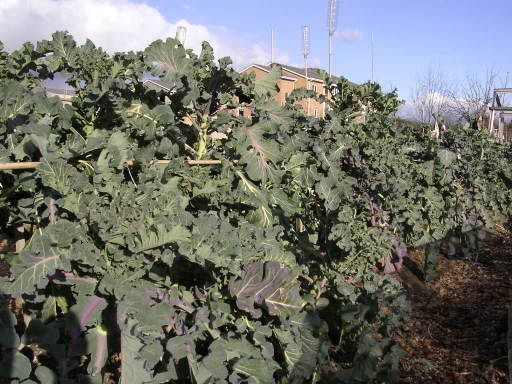
These PSB were planted in one of the first beds. Their roots went so deep it needed two of us to get them out of the ground
ps: some people call this approach the 'lasagne' method, so far it has worked better than any approach I've used in the past and I wish I'd figured it out years ago!
Allan wrote:Unless I missed it there has been no reference so far to the aspect that to me is all important, that is in preperation you must have to dig the whole bed to, I assume, one spit, approx 11 inches.
Hi Allan, true, lots of books say this step is essential, and I have done it in the past and what a chore it was
On this plot I never have I suppressed weeds with the black plastic over about two thirds of the plot. For 'instant' beds on the remaining third, I covered the marked out bed area with thick layers of soaked newspaper, then layers of compost, and whatever organic stuff - leaves, spent hops, well rotted manure (not for roots obviously!) and the topsoil from the paths. For a fine tilth seedbed on one of the beds, I sifted some compost over the top. Since starting off the beds, plant roots, worms, and harvesting, have loosened up the soil without digging. You still have to cart the compost etc. to the site, but there's no digging.
These PSB were planted in one of the first beds. Their roots went so deep it needed two of us to get them out of the ground
ps: some people call this approach the 'lasagne' method, so far it has worked better than any approach I've used in the past and I wish I'd figured it out years ago!
That's not PSB,Sprout,that's a hedge!
It's a leap of faith when you stop digging the ground,I worried that it would go rock hard and I wouldn't be able to get a trowel into it....but it doesn't happen.I don't add more composted matter than I would have on flat ground now they're up and running,which ever bed looks in need gets the lion's share and green manures get covered over to incorporate them,they just rot into the topsoil,they don't have to be dug in.
It's a leap of faith when you stop digging the ground,I worried that it would go rock hard and I wouldn't be able to get a trowel into it....but it doesn't happen.I don't add more composted matter than I would have on flat ground now they're up and running,which ever bed looks in need gets the lion's share and green manures get covered over to incorporate them,they just rot into the topsoil,they don't have to be dug in.
You have left me with a lot of topics to go further with but as I am booked to visit Bath and the Farmers Market today as a special treat(guess why) I won't have time to mention more than one.
We got the two rows of courgettes, marrows, spaghetties done.(we still don't know what Hasta La Pasta means but it is an orange fleshed one) My ground is called Old Red Sandstone which is not a clay, loam, sand or chalk.There is a large area of it in the West Midlands and Welsh Borders, I think Evesham is on it. The top is quite easily broken up with the cultivator but when you dig a hole you bring up solid lumps, If you tread on these or squeeze by hand they do break down to small particles but even with cultivation on and off for more than a decade as far as I can tell it doesn't stay that way for ever. Even where considerable organic matter has been added thce colour changes but it is still capable of compacting.
Allan
We got the two rows of courgettes, marrows, spaghetties done.(we still don't know what Hasta La Pasta means but it is an orange fleshed one) My ground is called Old Red Sandstone which is not a clay, loam, sand or chalk.There is a large area of it in the West Midlands and Welsh Borders, I think Evesham is on it. The top is quite easily broken up with the cultivator but when you dig a hole you bring up solid lumps, If you tread on these or squeeze by hand they do break down to small particles but even with cultivation on and off for more than a decade as far as I can tell it doesn't stay that way for ever. Even where considerable organic matter has been added thce colour changes but it is still capable of compacting.
Allan